Advancing Women’s Economic Empowerment through Innovative Collaborations
Key Takeaways from the Bayer Foundation x Million Lives Collective webinar, October 2025
On October 21 2025, the Million Lives Collective (MLC) brought together a diverse group of funders, innovators and public-sector leaders for a dynamic and timely webinar on collaboration and its place as a powerful tool for advancing women’s economic empowerment.
The event centred on the question ‘what becomes possible when collaboration is placed at the heart of women’s economic empowerment?’ and explored how supporting innovators to partner for impact can be a powerful mechanism for achieving inclusive outcomes at scale.. This blog shares the key takeaways from the webinar.
Setting the scene: What is the Million Lives Collective?
To kickstart the session, Jite Phido, Senior Programme Manager at the MLC and Results for Development, shared key background on the MLCand its role within the development innovation sector.
The MLC is a global network of actors who have demonstrated or are working towards development impact at a transformative scale. Managed by Results for Development, with an East Africa Regional Hub in Nairobi, the MLC works to find, connect, and amplify high-impact innovations around the world. Today, the MLC supports more than 140 innovations impacting over one billion lives across 130 countries.
Find out more about the MLC here.
Financing collaboration for scale: the Bayer Foundation x MLC Women’s Economic Empowerment Collaboration Grant
Before exploring the role of collaboration and innovative partnerships in driving impact at scale, the webinar familiarized participants with what the Bayer Foundation x MLC Women’s Economic Empowerment Collaboration Grant set out to achieve.
With a shared objective to advance women’s economic empowerment in Sub-Saharan Africa, the Million Lives Collective partnered with the Bayer Foundation, with support from the Bill & Melinda Gates Foundation, to launch this Collaboration Grant in 2023. The award was designed to accelerate collaboration between MLC Members and other high-impact organisations, exploring how their individual strengths could be combined to deliver greater impact for women.
Rather than funding a single solution, the initiative aimed to identify and test new collaborative models with the potential to increase incomes for 100,000 or more women in Sub-Saharan Africa by at least 30%.
Grant recipients received flexible funding alongside technical assistance to support in-field testing, learning, and the development of credible strategies for scale. Importantly, the grants were unconditional, reducing traditional funding pressures and providing recipients with a risk-free platform to experiment, make mistakes and pioneer genuinely impactful solutions.
Why do collaboration grants matter?
The collaboration grants were created to explore what becomes possible when impactful, proven innovations are encouraged to work together, not siloed, but in partnership.
Michael Schwall , Senior Consultant at the Bayer Foundation, shared that Bayer has a long history of supporting collaboration grants, particularly in rural contexts where health, agriculture, and livelihoods are deeply interconnected. He explained that the women’s economic empowerment award built on earlier successes, including collaboration models tested in Uganda, and offered a new opportunity to apply those lessons to women’s income generation.
Stefan Willhelm, Associate Director of Social Innovation at the Bayer Foundation added that the growing complexity of global challenges makes collaboration essential: “We are facing challenges that no single organisation will be able to solve on its own”, he said, highlighting the Foundation’s interest in catalytic partnerships that reduce burdens on grantees and support sustainable, long-term scale.
Collaboration grant awardees
Two collaboration pairs were selected for the initial test-and-learn phase of the award:
4Life Solutions partnered with the Maendeleo Ya Wanawake Organisation (MYWO) to economically empower women through entrepreneurship in water, sanitation, and hygiene (WASH), training members of women’s empowerment groups to sell solar-powered SaWa Cans in Kenya (add link).
D-Tree International and Medic collaborated with the Ministries of Health in Zanzibar and Zambia to design the Learn+ strategy; a scalable, government-aligned approach aimed at increasing the income of female Community Health Workers by at least 30%.
Following a highly successful test-and-learn phase, 4Life Solutions and MYWO were awarded follow-on funding to continue scaling their approach.
Why 4Life and MYWO collaboration stood out
4Life Solutions and MYWO’s model demonstrated that meaningful income growth for women is achievable when entrepreneurship, health, and community structures are intentionally aligned.
Caroline Githinji, Managing Director of 4Life Solutions, explained that the organisation’s mission is “safe water for all, improving public health while advancing women’s economic empowerment.”
Through strategic partnerships and social selling, 4Life works with women to deliver affordable, solar-powered water disinfection solutions without relying on electricity or charcoal.
Madam Rahab, National Chairperson of Maendeleo Ya Wanawake Organisation, highlighted the scale and reach of MYWO, which was founded in 1952 and today represents more than 4 million women across Kenya: “Our work is dedicated purely to empowering women from the grassroots,” adding that “when women are empowered and brought together, the impact goes far beyond numbers and transforms lives.” Madam Rahab emphasised that economic rights sit at the core of MYWO’s mission.
Together, the partnership delivered strong results during the pilot phase:
Nearly 3,000 SaWa Cans sold
Safe water reached more than 14,500 people directly
42% of participating women achieved at least a 30% income increase
Women reported improved business skills and household decision-making
Edwin, Training and Implementation Manager at 4Life Solutions, shared that this collaboration project showed that “empowered and trained women can drive income growth and expand access to safe water within their communities”, validating the project’s core goal.
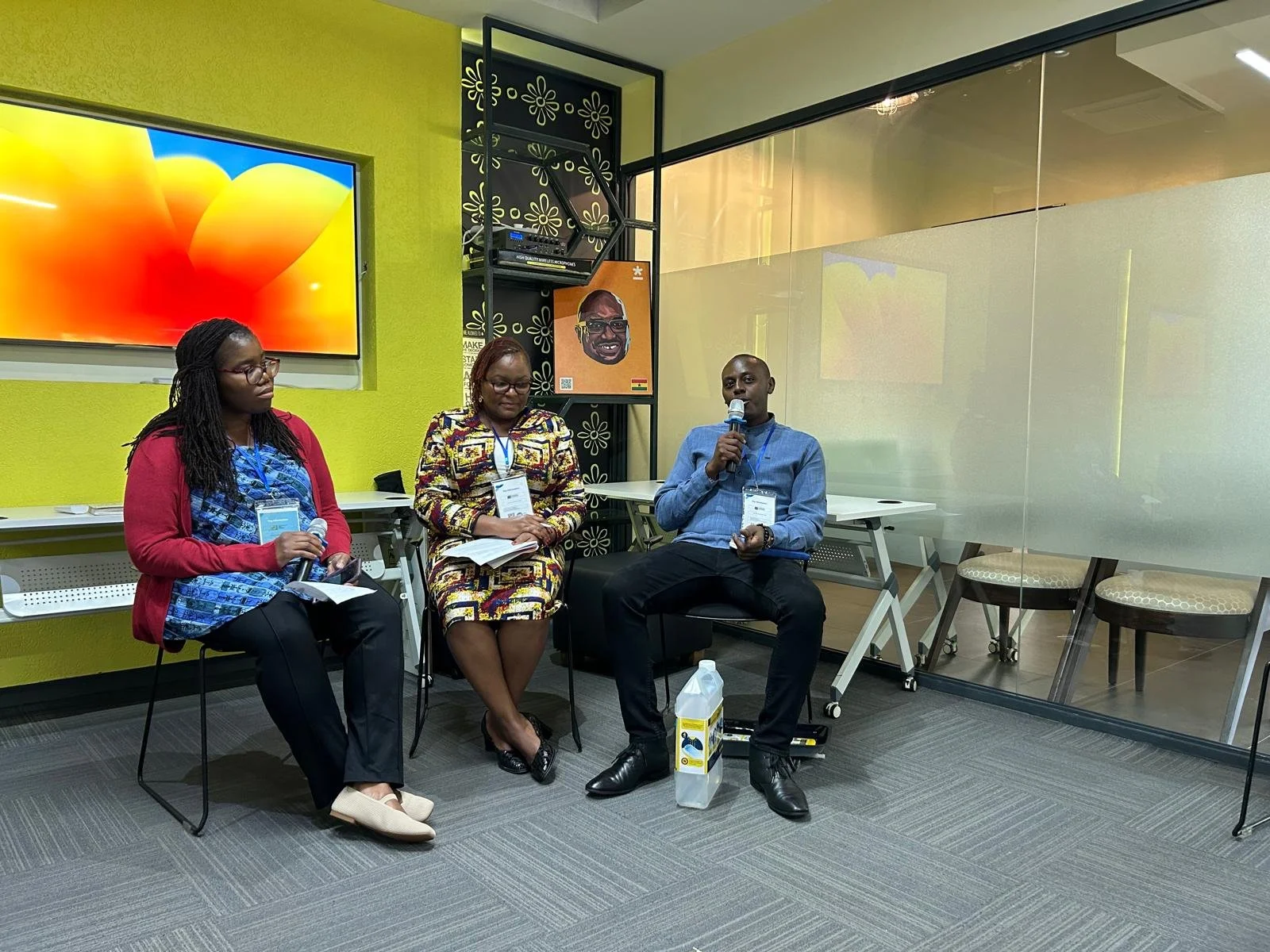
Jite Phido, Senior Programme Manager at Results for Development, Madam Rahab, National Chairperson of Maendeleo Ya Wanawake Organisation and Edwin, Training and Implementation Manager at 4Life Solutions participate in the panel discussion during the MLC workshop at the IDIA Global Summit in Nairobi, Kenya.
Perspectives from funders
Leesa Shrader, Deputy Director of the Gates Foundation’s women’s economic empowerment programme reflected on why the collaboration resonated with the Foundation’s strategy.
“We were at the beginning of a new strategy to test and learn what could really enhance women’s livelihoods,” she said, noting the shared passion with Bayer Foundation for reaching women operating in economies characterised by market failures and health and agricultural risks.
Leesa also underscored the difficulty and importance of the work in women's economic empowerment: “It’s possibly the most difficult challenge we face for poverty alleviation and economic development for Africa”.
Collaboration as a pathway to scale: panel discussion
The webinar concluded with a panel discussion exploring the question: Collaboration is a powerful pathway for scale, but what does it take to work across different systems and contexts?
Panelists included:
Joost Van Engen, Founder and CEO of Healthy Entrepreneurs
Dr Idah Kelly, Government of Kenya
Rowaida Naikkhwah, ASEEL Technology
Joost reflected on the role of funders in enabling partnerships, noting that collaborations supported by the Bayer Foundation have helped organisations work more closely with ministries and public-sector actors.
Dr Idah Kelly emphasised the role of government as a catalyst and convenor, helping innovators align with strategic plans, navigate procurement systems, and access public–private partnership pathways: “There is a role for the public sector in making it easier for innovators to partner with the government”, she said.
Rowaida Naikkhwah shared insights from ASEEL’s work supporting Afghan women through technology-enabled employment, highlighting how collaboration can create economic opportunities for women even in highly constrained environments.
Looking ahead
In response to the final question ‘what collaborations are needed in the next 12 months to amplify impact?’ panelists pointed to the need for deeper partnerships between governments, large foundations, and local organisations.
The webinar closed with the announcement that MLC, in partnership with the Judith Neilson Foundation, is launching a new collaboration grant focused on thriving urban futures in Africa. More details on the upcoming opportunity can be found here.
As this webinar discussion made clear, collaboration grants are not a silver bullet, but when designed intentionally and centred on innovators and end-users’ realities, they can unlock impact that no single actor can achieve in isolation.