AHD Nadi Filter
MLC Vanguard | Association for Humanitarian Development
AHD Nadi filter innovated in Hyderabad Sindh Pakistan during 2006-2006 with one 1 Nadi filter unit and then scaled 10 and 100 and 1,000 in 2008 and during 2010 floods. The Pakistan German Consulate and Help Alliance Germany helped 23,000 families and then up till 2019 reached 230,000 and from 2019 to 2025 AHD helped 9 African and 3 Asian Countries with trainings and scale up Nadi filters.
3,850,000 Lives Impacted
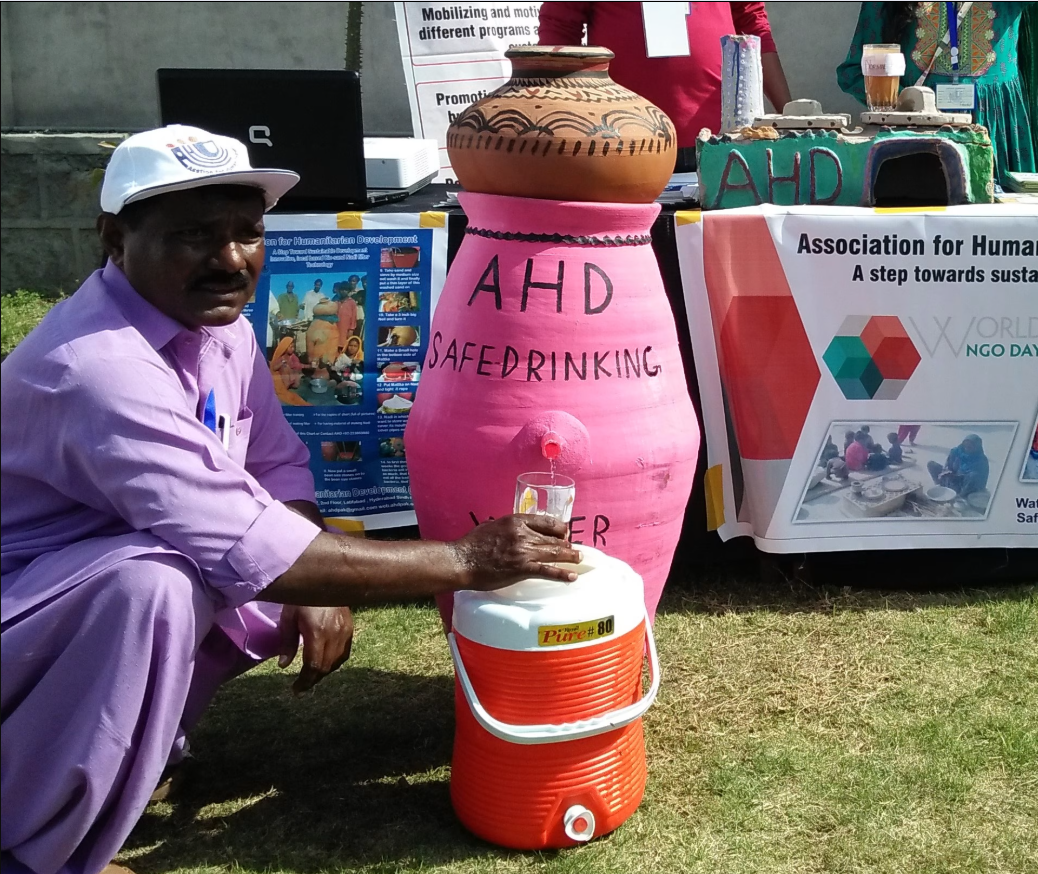
The AHD Nadi Filter is a local, nature-based solution that adapts the centuries-old slow sand filtration process using traditional mud pot technology.
The filter is made using simple, locally available materials, including:
Nadi
Mattaka
Pipes
Sand
Other locally sourced materials
The filter can be assembled within 5–6 hours using materials that are readily available across Pakistan and many African and Asian countries. Local mud pot makers and artisans produce the Nadi and Mattaka, while the remaining materials are purchased from local markets, meaning there is no need for imported components.
The Nadi Filter model is designed to be simple and community-led. Local communities are trained to build, operate, and maintain the filters themselves, rather than relying on external technicians.
The average cost of one Nadi Filter — which can serve a household of 8–20 people — is approximately USD 30–40. This cost includes materials, installation, transportation, training on operation and maintenance, as well as health and hygiene education.
Nadi Filters remove 95–99% of organic contaminants, including bacteria, viruses, protozoa, worms, and suspended particles. The filtered water is safe to drink and free from discoloration, unpleasant odour, and bad taste. Each filter can produce approximately 50–60 litres of clean water per hour.
The Innovation
Mr. Abdul Khurshid Bhatti is the President and CEO of the Association for Humanitarian Development (AHD) and has over 28 years of humanitarian experience. His work focuses on developing sustainable solutions to address public health crises, including cholera outbreaks, gastroenteritis, diarrhoea, plastic contamination in drinking water, and the overuse of chlorine and other chemicals in water treatment.
AHD first introduced a prototype of the Nadi Filter in 2005. In 2006, the organisation installed 10 Nadi Filter units in the Jati coastal area, where the technology proved successful. Building on this early success, AHD implemented 100 Nadi Filters in 2007 with support from ADP USA.
In 2008, the project received its first major international recognition through the APFED-UNEP Award. Since then, AHD and the Nadi Filter initiative have received eight international awards, including recognition from Energy Globe Austria, GSK UK, HIEX UN, and the World Health Assembly. The growing international recognition of the Nadi Filter has supported its adoption in multiple countries.
Mr. Bhatti’s vision is to support one million families in Pakistan through access to safe drinking water. To advance this goal, AHD has partnered with organisations including Blue Community Switzerland, Nature Based Solution Netherlands, Thrive Project Australia, and IUCN to expand the Nadi Filter solution across Pakistan and internationally.
By 2024, AHD Nadi Filters had successfully reached more than 365,000 families.
The AHD Nadi Filter project has been supported by a range of national and international donors and partners, including Misereor Germany, UNEP-APFED, WHO Pakistan, ADP, Oxfam GB, the CDP Government of Sindh, GlobalGiving, GSK–Save the Children UK, Care International, and Hope for Children UK, alongside corporate and individual donors.
In 2024, AHD further strengthened its international partnerships with Blue Community Switzerland, Thrive Project Australia, GlobalGiving USA, and several INGOs and NGOs to accelerate the expansion of the Nadi Filter solution in rural and low-income communities across Pakistan, Asia, and Africa.
About Association for Humanitarian Development
Vision: Socially and Economically, Just and Peaceful Society
Mission: Offer communities and institutions, the art and set of options, for their development, empowerment, institutional strengthening and continuous learning within their framework to live with human dignity, social justice, peace, and harmony.
Goal: AHD goals is to bring together the citizens from disadvantaged groups irrespective of their gender, class, religion or sect, have opportunities for growth, participation in local and national affairs which impact their lives.